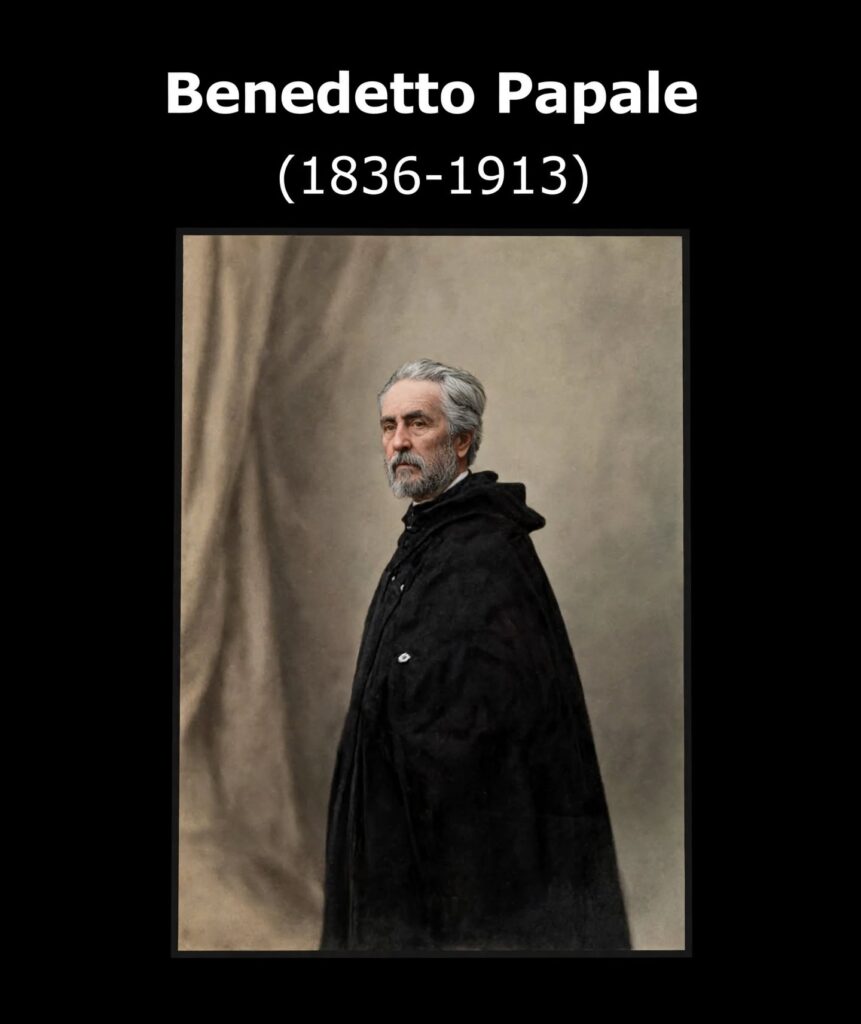
Dalla bottega paterna a Caltagirone fino al monumentale capolavoro del 1882 a Modica: la storia del religioso dei Minimi che trasformò la scenografia presepiale in grande arte verista
CALTAGIRONE – Esistono luoghi in cui la bellezza non è soltanto un esercizio estetico, ma una vocazione naturale inscindibile dal paesaggio. Caltagirone, con la sua architettura stratificata che di per sé richiama una quinta teatrale e una prospettiva multivisiva, è da sempre una fucina di modellatori, decoratori e scenografi. È in questo terreno fertile che affonda le radici la vicenda umana e artistica di Padre Benedetto Papale (1837-1913), figura centrale dell’arte sacra siciliana tra Ottocento e Novecento, ribattezzato a buon diritto “l’artista dell’infinitamente piccolo”.
Dalla falegnameria al saio dei Minimi
La storia comincia il 13 febbraio 1837 a Caltagirone, dove nasce Nicolò Papale, figlio di Antonino, un falegname locale che lo educa a una profonda e rispettosa devozione verso la Chiesa. È proprio la guida paterna a indirizzare il giovane verso il convento dell’Ordine dei Minimi a Milazzo. Sebbene in un primo momento Nicolò avesse accarezzato l’idea di indossare la veste talare del prete secolare, la persuasione del padre lo spinge infine a emettere i voti solenni sotto la regola di San Francesco da Paola – un santo il cui culto è ancora oggi vivissimo nella città calatina.
Assunto il nome di Padre Benedetto, il religioso si distingue presto per rigore morale, cultura e una rara capacità di leggere la realtà umana e spirituale, doti che lo porteranno a ricoprire l’incarico di Provinciale dell’Ordine dei Minimi.
L’arte come preghiera e lo sguardo verista
In Padre Benedetto la fede non frena la creatività, ma la amplifica. Nella spiritualità francescana, il Creato è l’opera d’arte per eccellenza e contemplarlo significa rendere lode a Dio. Le cronache e i saggi critici dell’epoca restituiscono l’immagine di un uomo dalle mani ossute, sempre pronte a plasmare piccoli frammenti di creta, gesso o sughero per dare vita a scene e personaggi intrisi del più autentico verismo siciliano.
Pur non nascendo come plasticatore puro, Padre Papale seppe affiancarsi ai migliori maestri figurinai del suo tempo, apprendendo e miniaturizzando l’arte delle celebri statuine calatine. La sua vera cifra stilistica risiedeva però nella regia scenografica e nella padronanza della prospettiva: le figure diventavano per lui gli attori di microcosmi monumentali, studiati al millimetro. Le sue opere varcarono presto i confini cittadini – dove oggi si ammirano, tra gli altri, presso la Chiesa di San Giuliano, al Museo Civico e in prestigiose collezioni private – per raggiungere Palermo, Ragusa e persino Malta.
Il capolavoro di Modica e il “sipario” di Natale
Il vertice assoluto della sua produzione resta tuttavia il monumentale presepe realizzato nel 1882 per la chiesa di Santa Maria di Betlem a Modica, un’opera che ancora oggi lascia senza fiato i visitatori e riempie d’orgoglio la comunità caltagironese.
A commissionare il lavoro fu il cavaliere Trombatore, guardiano procuratore della Confraternita di Santa Maria di Betlem. Padre Benedetto accettò l’incarico ponendo un’unica, ferma condizione: avere assoluta libertà artistica e interpretativa. Chiamò al suo fianco due straordinari maestri calatini della figurina, Giuseppe Vaccaro e Giacomo Azzolina, dirigendoli nella creazione di sessantasei statuine di diverse proporzioni.
Il frate scenografo incastonò quelle figure in un impianto prospettico mozzafiato, ispirato direttamente ai rilievi urbani della città di Modica e alle campagne circostanti. L’inaugurazione, avvenuta il 25 dicembre 1882, suscitò una commozione unanime tra i presenti. Per decenni, durante il resto dell’anno, quel piccolo universo di terracotta e sughero veniva celato alla vista dal grande dipinto di Santa Maria della Mercede, che all’avvicinarsi del Natale veniva sollevato come un sipario per restituire alla città la meraviglia di una Betlemme siciliana. Da qualche anno, fortunatamente, l’opera è visitabile in qualsiasi periodo dell’anno, consentendo anche ai tanti turisti che visitano la Sicilia nei mesi estivi di ammirarne la straordinaria bellezza.
L’eredità viva nei “carruggi” e l’ultimo saluto
In questo ritratto non si è voluto ancora affrontare un altro capitolo fondamentale della sua biografia, quello che lo vede geniale ideatore della Scala Illuminata: un ruolo talmente iconico da meritare un approfondimento dedicato esclusivamente al Padre Papale “scenografo della Scala”.
Il tempo, del resto, non ha scalfito minimamente la memoria del suo operato. Al contrario, nel suo nome e grazie a una riscoperta dei suoi insegnamenti avviata dalla fine degli anni Ottanta del Novecento, a Caltagirone è tornato a fiorire un ricco tessuto di laboratori artigiani. Ispirandosi direttamente alla lezione di Padre Papale, i maestri locali realizzano oggi scenografie e presepi nei materiali più diversi, disseminando opere d’arte nei più suggestivi e nascosti “carruggi” del centro storico. Un patrimonio diffuso che non delude mai le aspettative dei visitatori e che permette a Caltagirone di sedere a pieno titolo, accanto alla celebre San Gregorio Armeno di Napoli, nell’olimpo delle città italiane dei presepi monumentali.
Padre Benedetto Papale si spense il 19 aprile 1913, all’età di 76 anni, nella sua abitazione al civico 890 di via Cordova (l’attuale via Roma). A lui va, ancora oggi, l’affettuoso e riconoscente ringraziamento di tutti i presepisti.
(Liberamente tratto da “900” di A. Navanzino)
From the paternal workshop in Caltagirone to the monumental masterpiece of 1882 in Modica: the history of the religious of the Minimi who transformed the nativity scene into a great verist art
CALTAGIRONE – There are places where beauty is not only an aesthetic exercise, but a natural vocation inseparable from the landscape. Caltagirone, with its stratified architecture that in itself recalls a theatrical fifth and a multi-visual perspective, has always been a forge of modelers, decorators and set designers. It is in this fertile ground that the human and artistic story of Father Benedetto Papale (1837-1913), a central figure of Sicilian sacred art between the nineteenth and twentieth centuries, rightly renamed “the artist of the infinitely small”.
From carpentry to the know of the Minimi
The story began on February 13, 1837 in Caltagirone, where Nicolò Papale was born, son of Antoninus, a local carpenter who educated him of a deep and respectful devotion to the Church. It is precisely the fatherly guide to direct the young man towards the convent of the Order of Minimums in Milazzo. Although at first Nicolò had stroked the idea of wearing the talar robe of the secular priest, the persuasion of his father finally prompts him to issue solemn vows under the rule of St. Francis of Paola – a saint whose cult is still very much alive in the city of Calatina.
Assuming the name of Father Benedict, the religious soon distinguished himself by moral rigor, culture and a rare ability to read human and spiritual reality, qualities that will lead him to hold the post of Provincial of the Order of Minimums.
Art as prayer and the truthful gaze
In Father Benedict, faith does not curb creativity, but amplifies it. In Franciscan spirituality, Creation is the work of art par excellence and contemplating it means making praise to God. The chronicles and critical essays of the time return the image of a man with bony hands, always ready to shape small fragments of clay, chalk or cork to give life to scenes and characters steeped in the most authentic Sicilian verism.
Although not born as a pure plasticizer, Father Papale was able to work alongside the best master figures of his time, learning and miniaturizing the art of the famous Calatine figurines. His true stylistic figure, however, lay in the scenic direction and in the mastery of perspective: the figures became for him the actors of monumental microcosms, studied to the millimeter. His works soon crossed the city boundaries – where today you can admire, among others, at the Church of San Giuliano, at the Civic Museum and in prestigious private collections – to reach Palermo, Ragusa and even Malta.
Modica’s masterpiece and the Christmas “circult”
The absolute summit of his production remains, however, the monumental nativity scene made in 1882 for the church of Santa Maria di Betlem in Modica, a work that still leaves visitors breathless and fills the Caltagiro community with pride.
To commission the work was the knight Trombatore, guardian prosecutor of the Brotherhood of Santa Maria di Betlem. Father Benedict accepted the task by placing a single, firm condition: to have absolute artistic and interpretive freedom. He called alongside two extraordinary masters of the Calatini of the figurine, Giuseppe Vaccaro and Giacomo Azzolina, directing them in the creation of sixty-six statues of different proportions.
The set-up friar set those figures in a breathtaking perspective system, directly inspired by the urban reliefs of the city of Modica and the surrounding countryside. The inauguration, which took place on December 25, 1882, aroused a unanimous emotion among those present. For decades, during the rest of the year, that small universe of terracotta and cork was hidden from view by the great painting of Santa Maria della Mercede, which at the approach of Christmas was raised as a curtain to give back to the city the wonder of a Sicilian Bethlehem. For some years, fortunately, the work can be visited at any time of the year, allowing even the many tourists who visit Sicily in the summer months to admire its extraordinary beauty.
The legacy alive in the “carruggi” and the last greeting
In this portrait we did not want to face yet another fundamental chapter of his biography, the one that sees him brilliant creator of the Illuminated Staircase: a role so iconic as to deserve an in-depth study dedicated exclusively to the Papal Father “scenographer of La Scala”.
Time, moreover, did not scratch the memory of his work in the slightest. On the contrary, in his name and thanks to a rediscovery of his teachings started from the late eighties of the twentieth century, a rich fabric of artisan workshops has returned to Caltagirone. Inspired directly by the lesson of Father Papale, the local masters today create sets and nativity scenes in the most diverse materials, disseminating works of art in the most evocative and hidden “carruggi” of the historic center. A widespread heritage that never disappoints the expectations of visitors and that allows Caltagirone to sit in its own right, next to the famous San Gregorio Armeno in Naples, in the Olympus of the Italian cities of the monumental nativity scenes.
Father Benedetto Papale passed away on April 19, 1913, at the age of 76, in his home at 890 Via Cordova (the current Via Roma). To him goes, even today, the affectionate and grateful thanksgiving of all the cribs.
(Freely taken from “900” by A. Navanzino)