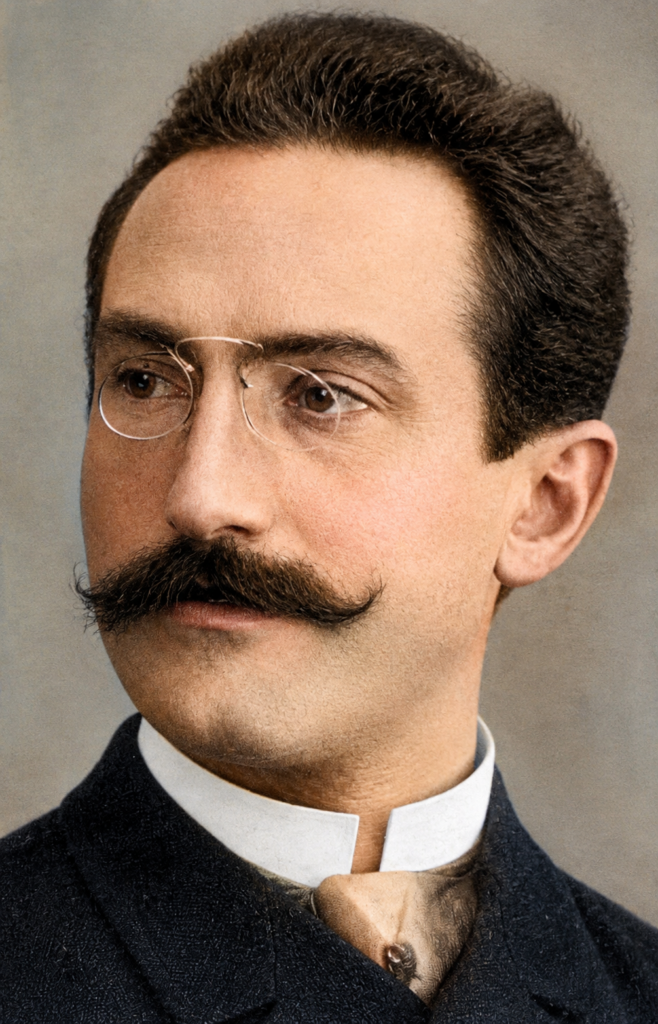
Giorgio Arcoleo nacque a Caltagirone il 15 agosto 1850 da Gaetano Arcoleo e Benedetta Alessi.
Studiò nella sua città natale fino al liceo, dimostrando fin da giovane una mente brillante e una spiccata propensione critica.
Lasciò poi Caltagirone per trasferirsi a Napoli e completare gli studi universitari.
Lì entrò a far parte della gloriosa scuola di Francesco De Sanctis e in questo periodo pubblicò un celebre studio sulla maschera di Pulcinella (in una nuova antologia del 1872) in cui si può già scorgere la sua passione per la ricerca letteraria, passione che non lo abbandonò mai più.
Ma il suo spirito fu attratto anche dagli studi giuridici, e tra questi prediligeva il Diritto Costituzionale, in un periodo caratterizzato da profonde divergenze tra gli studiosi.
Erano infatti in vigore due scuole di pensiero: quella “giuridica” e quella “politica”, a seconda delle prospettive che si volevano dare ai problemi che si presentavano.
Preferì realizzare una fusione intelligente, dimostrando anche con l’esempio l’utilità di integrare l’arido schematismo delle forme giuridiche con l’indagine storico-politica.
Per questi studi, iniziati nel 1875, ottenne una cattedra universitaria in giovane età.
La sua prima sede fu l’Università di Pavia, poi quelle di Palermo e Napoli.
Prediligeva Napoli, dove rimase un apprezzato professore fino alla sua morte, avvenuta il 7 luglio 1914.
Eletto membro del Parlamento a Catania nel luglio 1885, rimase in Parlamento fino al 1900 e fu più volte Sottosegretario di Stato.
Esercitò anche la professione di avvocato con grande raffinatezza e intelligenza.
Nel 1902 fu nominato Senatore.
Intorno al 1900 perse la vista, ma ciò non interruppe la sua poliedrica attività, che continuò a svolgere con immutato vigore.
Al Senato, il suo contributo alla discussione sulla riforma della Camera alta (1911) rimase memorabile.
Molti e preziosi studi letterari, politici e giuridici su di lui ci sono pervenuti, e testimoniano ancora oggi il suo genio e la vivacità del suo spirito.
Giorgio Arcoleo was born in Caltagirone on August 15, 1850, to Gaetano Arcoleo and Benedetta Alessi.
He studied in his hometown until high school, demonstrating from an early age a sharp mind and a well-defined critical tendency.
I then left Caltagirone and moved to Naples to complete my university studies.
There he was part of the glorious School of Francesco De Sanctis and in this period he published a very famous study on the mask of Pulcinella (a philosopher in a mask – in a new anthology 1872) in which one can already see his passion for literary investigation, a passion that never abandoned him again.
But his spirit was also attracted by legal studies and among them he preferred Constitutional Law in that period troubled by profound dissent among scholars.
in fact there were two schools in force: the “Legal” and the “Political”, according to the perspectives that one wished to give to the problems that arose.
He preferred to carry out an intelligent fusion, also supporting by example the usefulness of integrating the arid schematism of legal forms with historical-political investigation.
For these studies, which he began in 1875, he obtained a university chair at a young age.
The University of Pavia was its first seat, then that of Palermo and Naples.
He preferred Naples where he remained an acclaimed Maestro until his death on 7 July 1914.
Elected Member of Parliament in Catania in July 1885, he remained in the Chamber until 1900 and was Undersecretary of State several times.
He also practiced law with great refinement and intelligence.
in 1902 he was appointed Senator.
Around 1900 he lost his sight, but this did not stop his multifaceted activity, which he continued to carry out with unchanged vigor.
In the Senate, his part in the discussion on the reform of the Upper House (1911) remained memorable.
Many valuable literary, political and legal studies remain of him, which still bear witness to his genius and the liveliness of his spirit.
Lorem ipsum dolor sit amet, consectetur adipiscing elit. Ut elit tellus, luctus nec ullamcorper mattis, pulvinar dapibus leo.