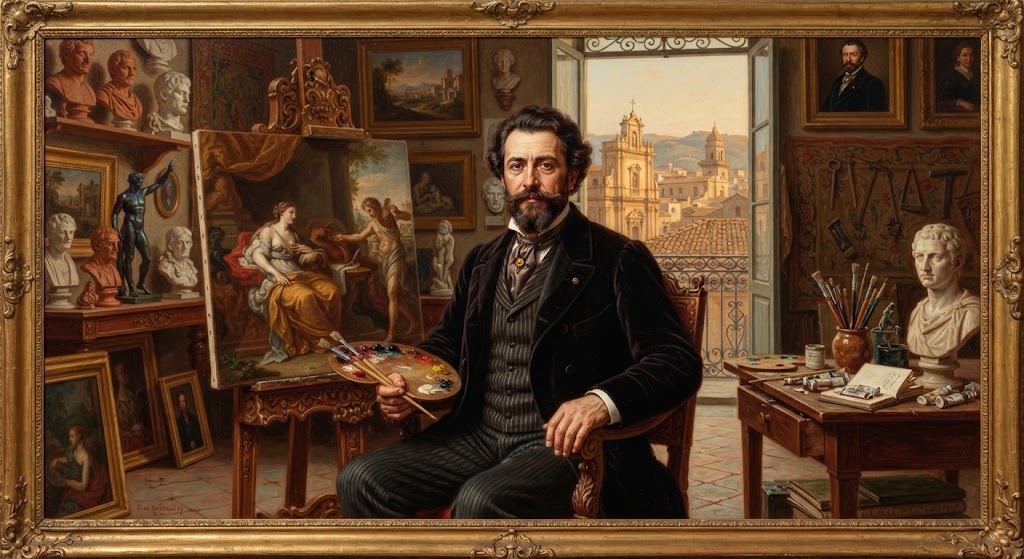
Francesco Vaccaro di 15 anni più giovane del fratello Giuseppe nel 1832, si trovava a Palermo e studiava presso la ” R. Accademia del Nudo” dopo un primo apprendistato a caltagirone nella bottega del fratello.
Le doti che il giovane veniva dimostrando indussero Giuseppe a sostenerlo, sopratutto economicamente, perchè potesse compiere gli studi necessari, aggiornare le conoscenze acquisite e contribuire poi più validamente all’attività comune.
Qualche anno più tardi, lo stesso Francesco indicò in Vincenzo Riolo e Giuseppe Platania e i suoi Maestri Palermitani.
Viene ricordato dai contemporanei come un Maestro generoso ( il Platania)largo di insegnamenti e di aiuto, e la sua scuola, frequentata dal Vaccaro come scrive per primo il Pappalardo che lo aveva appreso dalla viva vocedell’artista, che fù per molti giovani una meta d’obbligo, anche per i rapporti che vi si potessero intrattenere.
Da queste esperienze Francesco derivò una sua maniera misuratamente ecclettica, che negli anni successivi non mancò di affinare : entro un quadro di riferimenti ormai Sostanzialmente romantico, diede spazio a classicismi e realismo che riteneva componenti fondamentali della cultura artistica Italiana da ripensare in chiave moderna.
Ma bisogna avvertire che se arricchì le sue conoscenze e allargo il suo orizzonte culturale, il breve periodo di permanenza a Palermo non gli offri opportunità adeguate a colmare taluni insufficienze nel campo della tecnica , del disegno in particolare.
Non mancarono nè l’impegno nè la curiosità intellettuale del giovane ancora oggi attestate dalle “Accademie del Nudo” e dalle copie di Artisti del passato che si conservano nel Museo Civico al Carcere Borbonico di Caltagirone.
Con il rientro in patria, dopo non più di un anno di studio, ebbe inizio la consuetudine del lavoro comune con il fratello.
Un rapporto che non subì interruzioni e si allentò solo con la malattia di Giuseppe.
Diede luogo ad un sodalizio operoso ed anche efficace, basato sul reciproco rispetto e sui solidi legami familiari, e permise loro di fare fronte alle commissioni in taluni momenti piuttosto numerose.
In quale direzione fossero orientate le preferenze di francesco subito dopo il ritorno, è chiaramente indicata dal quadretto con l’incendio di judica, ricercato nel comporsi dei guerrieri che affrontano, e mettono in evidenza gli studi su modelli classici o di ascendenza classica.
ESTRATTO DA: “GIUSEPPE, FRANCESCO E MARIO VACCARO PITTORI DEL XIX SECOLO”
Francesco Vaccaro 15 years younger than his brother Giuseppe in 1832, was in Palermo and studied at the ” R. Accademia del Nudo” after a first apprenticeship in Caltagirone in his brother’s workshop.
The skills that the young man was showing led Joseph to support him, especially economically, so that he could carry out the necessary studies, update the knowledge acquired and then contribute more validly to the common activity.
A few years later, Francis himself pointed to Vincenzo Riolo and Giuseppe Platania and his Palermo Masters.
He is remembered by contemporaries as a generous Master (Platania) wide of teachings and help, and his school, attended by the Vaccaro as the first writes the Pappalardo who had learned it from the living voice of the artist, which was for many young people a must, also for the relationships that could be entertained.
From these experiences Francis derived a measuredly eclectic way, which in the following years did not fail to refine: within a framework of references now Substantially Romantic, he gave space to classicism and realism that he considered fundamental components of Italian artistic culture to be rethought in a modern key.
But it must be felt that if he enriched his knowledge and broadened his cultural horizon, the short period of stay in Palermo does not offer him adequate opportunities to fill certain shortcomings in the field of technique, drawing in particular.
There was no lack of commitment or the intellectual curiosity of the young man still today attested by the “Academies of the Nude” and by copies of Artists of the past that are kept in the Civic Museum at the Bourbon Prison of Caltagirone.
With the return home, after no more than a year of study, the custom of the common work with his brother began.
A relationship that did not suffer interruptions and only loosened with Joseph’s illness.
It gave rise to an industrious and also effective partnership, based on mutual respect and solid family ties, and allowed them to meet the committees at some rather numerous times.
In which direction were the preferences of francesco oriented immediately after the return, it is clearly indicated by the square with the fire of judica, sought in the composition of the warriors they face, and highlight the studies on classical models or classical ancestry.
EXCERPT FROM: “JOSEPH, FRANCIS AND MARIO VACCARO 19TH CENTURY PAINTERS”